



Across philanthropy, institutions designed for stability are now operating in conditions defined by volatility.
Boards built to steward philanthropic capital across generations are navigating economic instability, climate disruption, political polarization, demographic transformation, and technological acceleration—forces that do not unfold in linear sequence but compound and cascade.
Philanthropy’s core strengths remain indispensable: long-term capital, moral purpose, and the freedom to take risks others cannot.
Yet the governance structures that once optimized continuity may now unintentionally constrain adaptation.
As explored in the preceding field essay, leadership homogeneity within philanthropy is not merely a demographic pattern—it is a governance design outcome.
When authority is concentrated within socially similar networks, institutions risk narrowing the range of signals they detect, the assumptions they test, and the interpretations that shape strategy.
The challenge facing philanthropy is therefore not simply one of representation.
It is one of institutional intelligence.
When environments become more complex than the governance systems interpreting them, institutions must either expand their interpretive capacity or risk making increasingly fragile decisions.
Pluralistic Leadership offers a framework for strengthening that intelligence by redesigning how authority is distributed and how institutions interpret complex environments.
This article introduces Pluralistic Leadership as articulated in the Version 1.0 open framework developed through the Future Funders Initiative.
The Limits of Homogeneous Governance
Across the field, governance remains highly concentrated. Family foundations constitute more than half of all private foundations, with a median board composed entirely of family members and a significant majority of seats held by family trustees. National data show that foundation CEOs and trustees remain overwhelmingly white.
Leadership homogeneity does more than limit representation. It narrows the range of assumptions tested inside governance rooms. It shapes which risks feel legible, which signals are amplified, and which interpretations dominate strategic conversations.
In stable conditions, homogeneity can appear efficient. In complex conditions, it becomes a liability.
When institutions operate in environments defined by rapid change and interdependence, resilience depends not on unanimity of perspective but on the ability to surface and integrate differentiated forms of knowledge. Governance structures optimized for cohesion and continuity may unintentionally suppress the very signals required for adaptation.
This tension is not primarily moral. It is structural.
Institutional designs reward continuity. Board recruitment practices reinforce familiarity. Informal hierarchies sustain precedent. Over time, leadership patterns become normalized—not because alternatives are illegitimate, but because continuity feels safer than experimentation.
Pluralistic Leadership responds not by rejecting philanthropic tradition, but by evolving its leadership design.
What Is Pluralistic Leadership?
Pluralistic Leadership is a governance design framework for navigating complexity.
It organizes authority around three structural commitments:
Shared interpretive authority rather than centralized control
Multiple forms of knowledge rather than singular expertise
Collective sensemaking rather than unilateral interpretation
Pluralistic Leadership does not eliminate fiduciary responsibility or executive authority. It does not dissolve accountability. It expands the epistemic base from which decisions are made.
Difference—across lived experience, discipline, identity, and role—is treated not as disruption to be managed, but as strategic intelligence necessary for navigating uncertainty.
Pluralism in this sense is not consensus governance. It is not demographic representation as an end in itself. It is not advisory participation without authority. It is the intentional expansion and sharing of interpretive and decision-making authority within existing fiduciary structures.
By widening who contributes to strategic interpretation, foundations strengthen their capacity to assess risk, anticipate unintended consequences, and align mission with evolving realities.
Pluralistic Leadership is additive rather than subtractive. It strengthens stewardship by broadening the range of tools available to interpret complexity.
Pluralistic Leadership expands institutional intelligence by widening interpretive authority.
The Six Design Principles
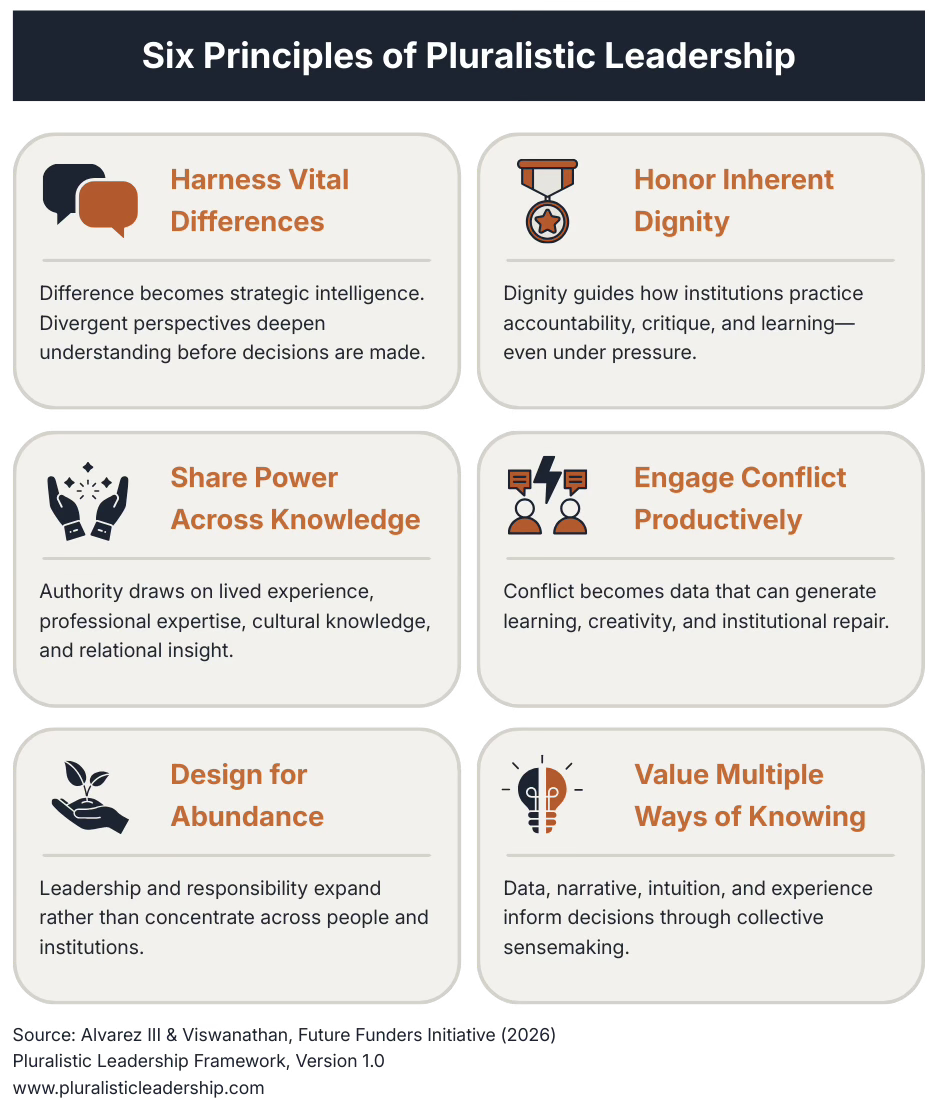
Pluralistic Leadership rests on six interrelated principles. These principles function not as aspirational values statements, but as design lenses that shape how authority is distributed and how institutions process information.
Harness vital differences in service of the greater good.
Divergent perspectives are surfaced intentionally to deepen understanding rather than rush prematurely toward alignment.Honor inherent dignity and the worth of every person.
Accountability and critique are practiced in ways that preserve trust and relational integrity.Share power across life experiences and knowledge systems.
Authority is informed by lived experience, professional expertise, cultural knowledge, and relational insight.Engage conflict as a pathway to repair and creativity.
Tension is treated as information—data that can refine strategy and strengthen institutional coherence.Design for abundance, not scarcity.
Leadership and responsibility are expanded rather than hoarded, resisting zero-sum assumptions about authority.Value multiple forms of knowing in every decision.
Quantitative data, narrative insight, intuition, and experience are integrated through collective interpretation.
Taken together, these principles describe leadership as collective intelligence—embedded not in personality, but in governance norms, meeting practices, and authority distribution.
Pluralistic Leadership is infrastructure. It shapes how institutions learn.
Intellectual Lineage
Pluralistic Leadership synthesizes established traditions that treat leadership as relational, adaptive, and distributed rather than singular and hierarchical.
It draws from:
Social work and systems-thinking traditions that emphasize interdependence and contextual awareness
Indigenous and decolonial approaches to governance that center relational accountability
Pluralist political traditions recognizing the legitimacy of multiple truths in shared decision-making
Organizational design and adaptive leadership scholarship focused on learning under uncertainty
This framework does not claim novelty. It brings these traditions into conversation as practical design guidance for philanthropic governance in complex systems.
Proximate Leaders and Institutional Intelligence
Pluralistic Leadership is often operationalized through the inclusion of proximate leaders—individuals who maintain lived connection to the consequences of institutional decision-making while navigating governance systems with fluency.
Proximity is not synonymous with demographic identity alone. It refers to sustained experiential connection combined with fiduciary competence and systems literacy.
When proximate leaders hold genuine authority—as trustees, executives, or senior decision-makers—institutions expand their interpretive range. They integrate forms of knowledge that may otherwise remain peripheral to formal governance conversations.
This inclusion is not symbolic diversification. It represents a structural expansion of institutional intelligence.
The distinctive capacities proximate leaders bring—and why they represent a strategic advantage rather than a pipeline challenge—are explored more fully in the next article.
Why Pluralistic Leadership Is Difficult
Pluralistic Leadership challenges inherited institutional design rather than individual intent. Expanding interpretive authority requires structural shifts that generate predictable tension.
Governance Anxiety
Within institutions where stewardship has historically been equated with centralized control, expanding authority can feel destabilizing. Concerns about efficiency, clarity, and risk exposure are understandable.
Redistributing interpretive authority does not eliminate fiduciary responsibility—but it does alter how authority is exercised. That shift can produce uncertainty, particularly within family or founder-led contexts where governance is intertwined with legacy and identity.
Cultural Inertia
Philanthropy’s governance culture has long privileged certainty and certain kinds of expertise. These instincts protect assets and signal prudence. Yet in volatile environments, overreliance on certainty can dampen curiosity and constrain learning.
Pluralistic Leadership asks institutions to tolerate ambiguity long enough to integrate differentiated perspectives. That practice requires cultural muscle that may not yet be fully developed.
Institutional Rigidity
Traditional bylaws, committee structures, and evaluation frameworks were designed for predictability. Even well-intentioned leaders may find their aspirations constrained by inherited governance architecture.
Without intentional redesign of meeting practices, onboarding processes, and decision protocols, expanded authority risks remaining symbolic rather than structural.
Emotional Labor
Pluralistic Leadership requires institutions to engage conflict as information rather than dysfunction. This shift demands emotional stamina and relational maturity across leadership roles.
These are structural capacities—not personality traits. They can be designed, practiced, and strengthened over time.
When tension surfaces, it is not evidence of failure. It is feedback from the system—an indicator that governance patterns are stretching toward greater alignment with contemporary conditions.
Institutional evolution is inherently demanding. But stagnation carries its own risks.
Pluralistic Leadership as Field-Level Infrastructure
Pluralistic Leadership is not a program or checklist. It is field-level infrastructure—a shared orientation for interpreting leadership under conditions of complexity.
Infrastructure endures beyond individuals. It shapes norms, expectations, governance patterns, and decision-making cultures across institutions.
Its value lies in:
Expanding institutional foresight
Strengthening legitimacy and trust
Increasing adaptive capacity
Aligning governance with contemporary realities
Initiatives such as the Future Funders Initiative represent one pathway for supporting this evolution—focusing on leadership design, governance practice, and pathways for integrating differentiated forms of knowledge into positions of authority.
Pluralistic Leadership does not reject philanthropic tradition. It evolves it.
Foundations that broaden interpretive authority increase their ability to anticipate risk, adapt strategy, and sustain legitimacy over time.
If this framework represents the structural evolution philanthropy requires, the next question becomes clear:
Who embodies this form of leadership—and what distinctive capacities do they bring?
That is where we turn next.
Framework Reference
Pluralistic Leadership is an open framework developed by Tomás Alvarez III and Uma Viswanathan through the Future Funders Initiative.
The canonical Version 1.0 document, including licensing and citation guidance, is available here:
Please credit the authors and the Future Funders Initiative when referencing or sharing.
