




In the first article, we introduced Pluralistic Leadership as a governance design framework for navigating complexity.
That articulation draws from the Version 1.0 open framework developed through the Future Funders Initiative, which defines pluralistic leadership as the intentional expansion and sharing of interpretive and decision-making authority within existing fiduciary structures.
If governance expands interpretive authority, then leadership selection criteria must evolve accordingly.
Pluralistic design increases the range of perspectives informing decisions. That expansion requires leaders capable of operating within distributed intelligence—integrating difference without retreating into control or collapsing into indecision.
Across philanthropy, this conversation is often framed as a pipeline challenge: how to diversify leadership, how to recruit from underrepresented communities, how to widen representation.
But this framing obscures the structural question.
The constraint is not readiness.
It is whether institutions are prepared to recognize the forms of intelligence required under contemporary conditions.
Proximate leaders are not a talent shortage to be addressed. They represent a leadership advantage that becomes increasingly visible as complexity intensifies.
What We Mean by Proximate Leadership
Proximate leaders maintain sustained connection to the consequences of institutional decision-making while navigating governance systems with fluency.
Proximity is not reducible to demographic identity. It is lived familiarity with how systems function on the ground—combined with the ability to operate inside formal authority structures.
These leaders move between institutional and community contexts without losing coherence in either. They interpret policy and strategy not only from within boardrooms, but from within lived ecosystems.
When institutions treat proximity as symbolic inclusion, they reduce structural intelligence to optics.
Pluralistic Leadership recognizes proximity as interpretive capacity.
The Capacities Required by Pluralistic Governance
Pluralistic governance expands interpretive inputs. It surfaces more perspectives, more tensions, and more contextual signals.
That expansion requires leaders capable of metabolizing complexity without defaulting to premature certainty.
Proximate leaders often develop precisely those capacities because they have navigated layered systems long before entering formal governance roles.
These capacities are not stylistic preferences.
They are adaptive advantages.
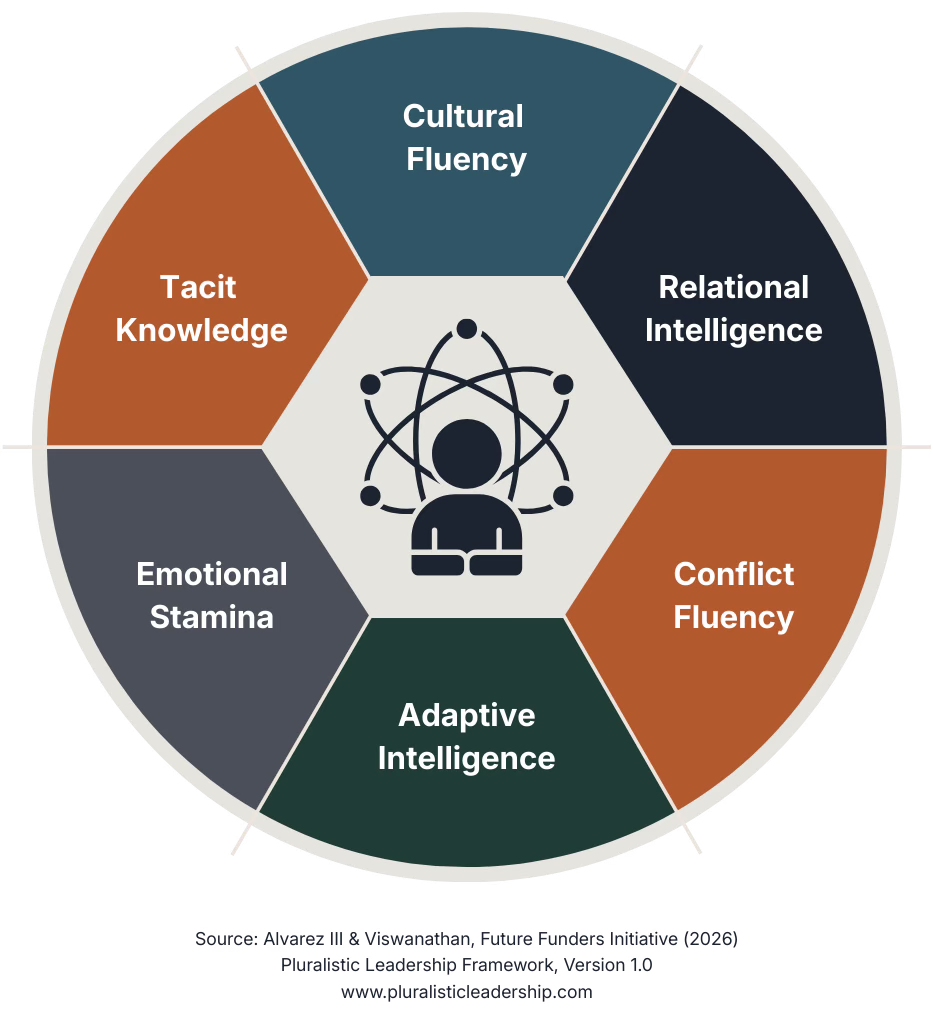
1. Tacit Knowledge: Detecting Signals Before They Become Crises
Traditional governance relies heavily on formal reporting cycles and quantitative dashboards. These tools are essential—but they are lagging indicators.
In volatile systems, lagging indicators produce lagging decisions.
Proximate leaders frequently develop contextual acuity that detects friction before it registers in institutional metrics. They notice emerging strain, shifting community sentiment, policy backlash, or implementation breakdown before those signals escalate.
Institutions that rely solely on formal data will consistently react later than conditions require.
Tacit knowledge strengthens foresight. Foresight strengthens stewardship.
2. Cultural Fluency: Reducing Translation Failure
Strategic misalignment often occurs not because of flawed intent, but because of translation failure.
Policies crafted in governance rooms encounter realities they were not designed to accommodate.
Proximate leaders often operate across multiple cultural, institutional, and socioeconomic contexts. They translate institutional strategy into lived environments and lived environments back into institutional deliberation without flattening nuance.
When translation capacity is embedded within authority, misalignment decreases.
When it is externalized, institutions risk funding strategies that appear coherent internally but function poorly in practice.
3. Adaptive Intelligence: Governing Under Volatility
Governance optimized for control performs well in stable environments.
Governance optimized for adaptation performs better in volatile ones.
Pluralistic Leadership increases interpretive diversity. That diversity introduces complexity. Leaders must navigate ambiguity without retreating into rigidity or suppressing dissent.
Proximate leaders often develop adaptive intelligence through operating in resource-constrained, rapidly shifting environments. They learn to recalibrate without abandoning mission.
In dynamic systems, rigidity masquerades as prudence.
Adaptation preserves relevance.
4. Conflict Fluency: Treating Friction as Information
Homogeneous governance cultures frequently equate visible disagreement with instability.
But suppressed conflict does not disappear. It accumulates.
Pluralistic Leadership depends on the ability to surface and integrate difference. That requires conflict fluency—the capacity to remain engaged when tension emerges and to interpret discomfort as data rather than disruption.
Proximate leaders often cultivate this capacity through navigating environments where competing interests and asymmetrical power are constant realities.
When boards avoid friction, they avoid learning.
When they harness it, blind spots narrow.
5. Relational Intelligence: Legitimacy as Infrastructure
Financial prudence alone does not secure legitimacy.
Legitimacy is sustained through relational accountability—ongoing dialogue, reciprocal engagement, and demonstrated responsiveness.
Proximate leaders frequently cultivate dense relational networks grounded in trust rather than transaction. These networks provide real-time feedback, historical context, and reputational stability.
Institutions disconnected from lived ecosystems often discover misalignment only after damage has occurred.
Relational intelligence shortens that lag.
6. Emotional Stamina: Holding Authority Amid Scrutiny
Expanding interpretive authority surfaces critique. It challenges precedent. It tests identity.
Leaders operating within pluralistic governance must remain steady while assumptions are examined and authority is shared.
Proximate leaders often develop emotional stamina through navigating scrutiny long before holding formal power. This resilience becomes an institutional asset when governance evolves.
Pluralistic Leadership is not comfortable leadership.
It is resilient leadership.
What Conventional Leadership Models Were Designed to Measure
Most leadership selection processes were designed for environments where predictability was the norm.
They privilege signals of stability:
Linear career progression
Institutional pedigree
Technical specialization
Familiarity with existing governance culture
These indicators remain valuable.
But they do not fully measure:
Contextual acuity
Translation under tension
Adaptive recalibration
Conflict integration
Relational legitimacy
When these capacities remain invisible in selection criteria, institutions mistake conformity for competence.
Pluralistic Leadership reframes competence in light of environmental change.
What Foundations Gain
When proximate leaders hold genuine authority—not advisory participation, not symbolic inclusion, but fiduciary power—governance dynamics shift.
Institutions gain:
Earlier detection of strategic risk
Broader interpretation of impact
Greater elasticity under volatile conditions
Stronger relational legitimacy
Reduced reputational fragility
These are not reputational benefits.
They are operational advantages.
In complex systems, interpretive depth determines strategic durability.
Institutions that expand authority expand intelligence.
Institutions that do not will increasingly operate with partial sight.
Beyond Representation
Pluralistic Leadership does not argue that proximity replaces expertise.
It argues that expertise alone is insufficient under conditions of complexity.
Proximate leadership is not an identity claim.
It is a structural asset within pluralistic governance design.
If governance broadens interpretive authority, then leadership must reflect the forms of intelligence required to operate within that broader field.
That alignment is not ideological.
It is architectural.
The Question Ahead
If proximate leaders bring capacities forged through complexity—contextual acuity, adaptive judgment, conflict fluency, relational legitimacy—then the question shifts.
The question is not whether they belong in positions of authority.
It is whether philanthropy can afford to operate without the capacities they bring.
That is where we turn next.
Framework Reference
Pluralistic Leadership is an open framework developed by Tomás Alvarez III and Uma Viswanathan through the Future Funders Initiative.
The canonical Version 1.0 document, including licensing and citation guidance, is available here:
Please credit the authors and the Future Funders Initiative when referencing or sharing.

