



Institutions do not simply make decisions.
They interpret reality.
Boards, executives, and governance bodies receive signals from complex environments—community needs, economic shifts, political pressures, and lived experience—and translate those signals into strategic action.
The quality of those interpretations shapes the quality of institutional decisions.
This capacity can be understood as institutional intelligence.
Institutional intelligence refers to an institution’s ability to interpret complex conditions, integrate multiple forms of knowledge, and make decisions under uncertainty.
Within the Pluralistic Leadership framework, institutional intelligence becomes the central lens through which governance design and leadership composition can be understood.
In complex environments, the question facing institutions is not simply who leads.
It is how leadership systems interpret the world.
Governance Shapes What Institutions Can See
Leadership conversations often focus on individual qualities—credentials, experience, or management skill.
But institutions rarely struggle because leaders lack talent.
More often, they struggle because the systems through which leaders interpret reality are too narrow.
Governance design influences:
which signals are noticed
which interpretations carry authority
which risks appear legible
which possibilities remain invisible
Institutional intelligence operates as a continuous cycle through which institutions interpret signals, make decisions, and learn from outcomes.
The Pluralistic Leadership framework refers to this process as the Institutional Intelligence Cycle.
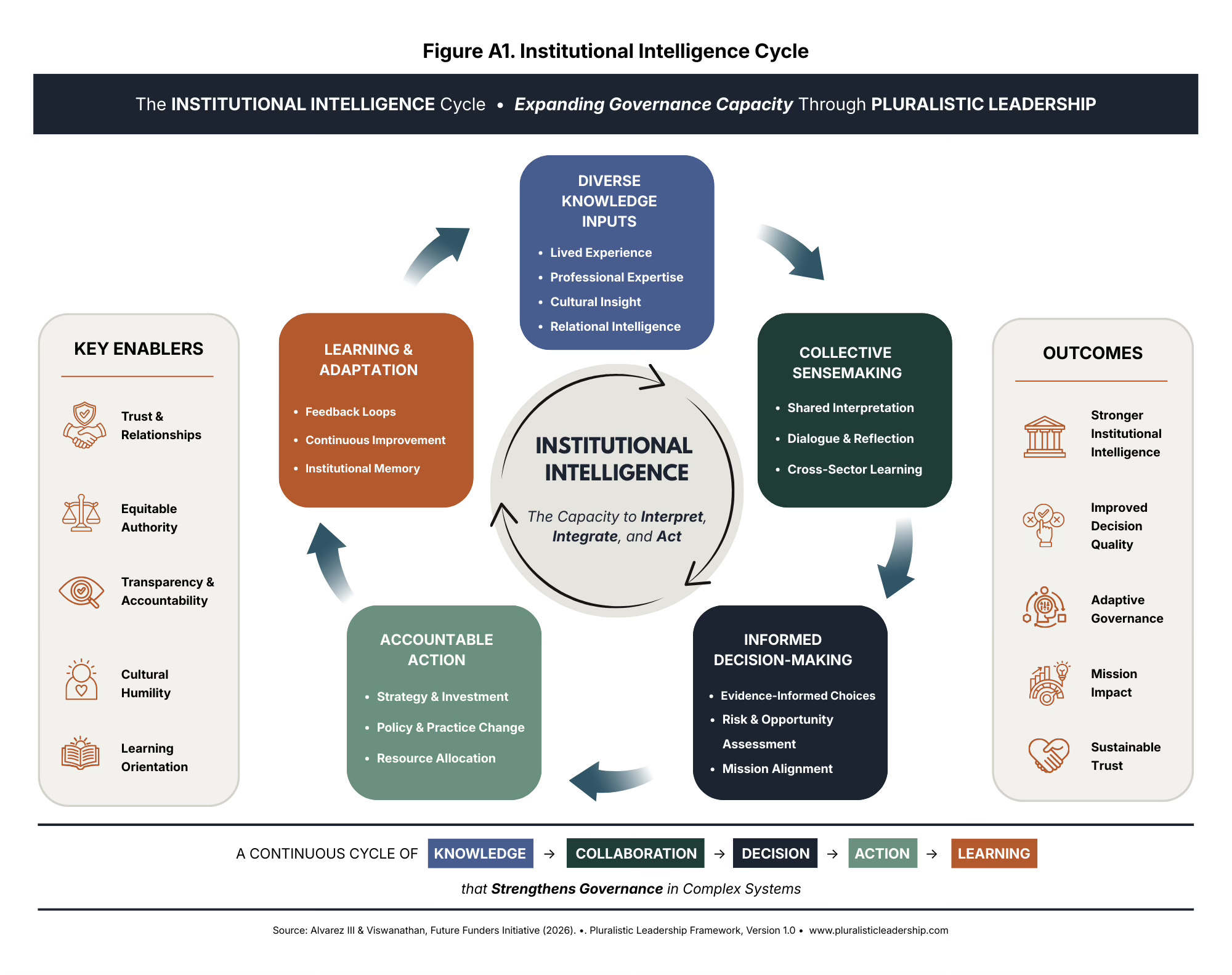
A full explanation of the cycle appears in the Pluralistic Leadership Framework (Version 1.0).
The Limits of Homogeneous Leadership
Leadership homogeneity is often framed as a question of representation.
But its institutional consequences run deeper.
When leadership networks share similar social pathways and governance assumptions, they often share similar interpretive frames. Signals that reinforce those assumptions travel easily. Signals that challenge them may remain peripheral.
In complex systems, this can narrow the range of signals institutions perceive.
Institutional intelligence declines not because leaders lack commitment or capability, but because the interpretive system itself has limited range.
A deeper exploration of this dynamic appears in:
Philanthropy’s Wicked Problem: Leadership Homogeneity as a Governance Design Failure.
Expanding Institutional Intelligence
Pluralistic leadership expands institutional intelligence by widening interpretive authority and integrating multiple forms of expertise—including professional knowledge, lived experience, cultural insight, and relational understanding.
When institutions broaden the perspectives participating in interpretation, they become better able to detect emerging risks, understand social complexity, and adapt strategy as conditions evolve.
Institutional intelligence increases not because authority disappears, but because interpretation becomes more robust.
The Role of Proximate Leadership
One way institutions expand their interpretive range is through the inclusion of proximate leaders—individuals who maintain lived connection to the consequences of institutional decisions while navigating governance systems with fluency.
When proximate leaders hold meaningful authority within governance systems, they bring signals into decision-making conversations that might otherwise remain unseen.
Their presence expands the institution’s interpretive field.
The distinctive capacities proximate leaders bring to institutions are explored further in Part II of the Pluralistic Leadership series.
A Design Question
Institutional intelligence is not fixed.
It is shaped by governance design.
Leadership structures, meeting norms, and authority distribution all influence how institutions interpret reality.
Pluralistic Leadership begins from this premise:
If institutional intelligence is shaped by governance design, then strengthening institutional intelligence requires redesigning how authority itself is structured and shared.
Invitation to the Pluralistic Leadership Series
If institutional intelligence is shaped by governance design, a natural question follows:
How must leadership systems evolve to interpret complexity more effectively?
The Pluralistic Leadership series explores this question.
Next in the series
Part I — The Case for Pluralistic Leadership: Designing Authority for Complex Systems
